A missing hand or snapped connector can stop a build, but it does not automatically mean buying the whole kit again. Start by identifying the exact part, check the manufacturer's support route, then look for a genuine spare if you still need one.
This guide separates those steps so you can make a useful request the first time—and avoid ordering a part that looks right but belongs to a different version.
Identify the part before shopping
Keep the box and instruction manual beside you. Write down the manufacturer, full kit name, grade, scale, and version. Then find the runner letter and part number in the assembly step. A request for “an RX-78 hand” leaves too much room for error; several kits can depict the same mobile suit with completely different connections.
Kit identity: copy the complete name from the box, including Ver.Ka, Ver.2.0, or other version wording.
Part identity: record the runner label and number, including suffixes such as A1 or A2.
Quantity: say how many pieces you need and whether an entire runner is acceptable.
Finish: specify standard color, clear, plated, or another special edition.
Condition: state whether you need an uncut piece or would accept a carefully removed one.
If the manual is missing, search Bandai's official instruction-manual library using the full kit name or product number. Confirm the cover matches your box before using its part references. Similar names are not proof of compatibility.
Check Bandai's replacement route first
As checked September 11, 2026, Bandai Namco Toys & Collectibles America's policy covers certain defects and broken or lost model-kit components, with a cap of six parts per kit purchase. Purchases and customers must be in the U.S. or Canada; APO, FPO, and PO Box delivery is excluded. Availability limits apply.
The page gives a request window of under 90 days from receipt/delivery and a separate provision for direct convention or pop-up purchases with a Bandai Namco receipt. It asks for original images of the affected part, full receipt, packaging warning sticker, and UPC. Do not crop or alter those submission images.
It also excludes “collectible items” on the market for eight months or longer, without clearly explaining how that wording applies to reissued model kits. Ask Bandai about your specific case rather than assuming a reissue qualifies or is excluded. Premium Bandai purchases have a separate support route linked there. Read the current official policy and form before filing; approval is not guaranteed.
If the part was missing when the box arrived
Photograph the contents and keep the packaging, runners, receipt, and shipping materials while you contact the seller. Describe what you found without trimming or modifying the affected area first. A missing runner, a duplicate runner, and a part that broke during assembly are different situations; clear details help support direct the request.
For an Artrovo Gundam purchase, use the contact page with your order reference and the kit and part details. Keep order information in that private support conversation, rather than posting it in a public marketplace listing. A shop inquiry and a manufacturer replacement request are separate processes; neither should be treated as a promise that a spare is available.
Find a genuine spare on the Bounty Board
The Artrovo Gundam Bounty Board is where builders can look for genuine spare parts and runners. Browse For Sale listings for an existing match, or create a Wanted request with the identifiers you collected.
Use this format for a clear listing:
Wanted: [full kit name], [grade/scale/version], runner [label], part [number]
Quantity: [number]. Finish: [standard/clear/plated]. I can accept [uncut part / carefully removed part / complete runner]. Please show the actual item, runner label if available, and the connector area. My photo shows the manual step for identification.
Replace every bracketed item before posting. For a damaged piece, include a sharp photograph of the break and another showing its position on the model. These are photos of your specific problem, not generic internet examples. You can keep personal details out of marketplace photos; that differs from Bandai's requirement for unaltered support images submitted privately.
Check an offer before paying
Compare the offered item with your manual and box information. Ask whether any gates were cut deeply, joints stressed, pegs shortened, or surfaces glued or painted. A part described as “used” may still suit your build, but you should know what you are buying.
For a connector, request a clear view of both ends. For a plated or clear piece, inspect the finish rather than relying only on its color name. Count any companion pieces needed for the assembly: an outer armor shell alone may not solve a missing joint.
Review the item price, shipping, applicable fees, and current marketplace policies before checking out. A Wanted post helps you search; it does not reserve stock or guarantee an offer.
When another full kit makes sense
Compare the delivered cost of the spare with a complete kit only after you know what is missing. A replacement kit can be practical if several assemblies are damaged or you want a second build. Check the exact version, finish, contents, and availability before ordering from the Gunpla and mecha department.
Keep full-kit shopping separate from runner trading. A store listing for a complete kit is not an offer to sell its individual parts, and distributor availability does not mean a spare runner is sitting in the shop.
Where custom printing fits
Artrovo Gundam's FDM service is for original or authorized custom designs such as display bases, organizers, and custom accessories. We do not reproduce official kit parts. A file copied or scanned from a missing manufacturer part is not a substitute for sourcing a genuine spare through the routes above.
For future builds, keep the manual and labeled leftover runners until you are sure you no longer need them. Our first-build tools guide also explains the basic cutting and cleanup tools that help you work carefully.
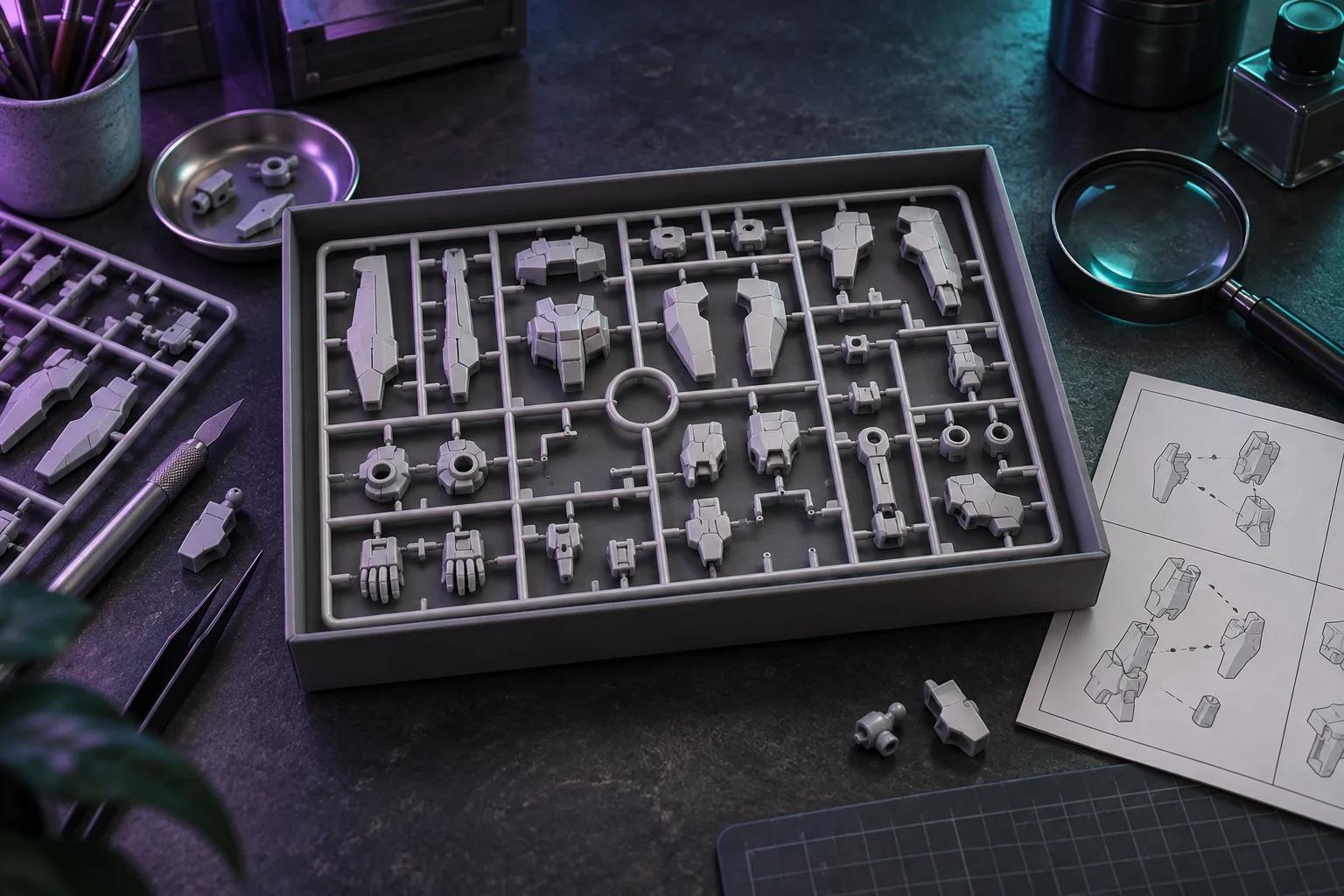
Editorial review: September 11, 2026. Cover: AI-generated conceptual illustration of parts sorting, not a photograph of an available runner or a completed repair.