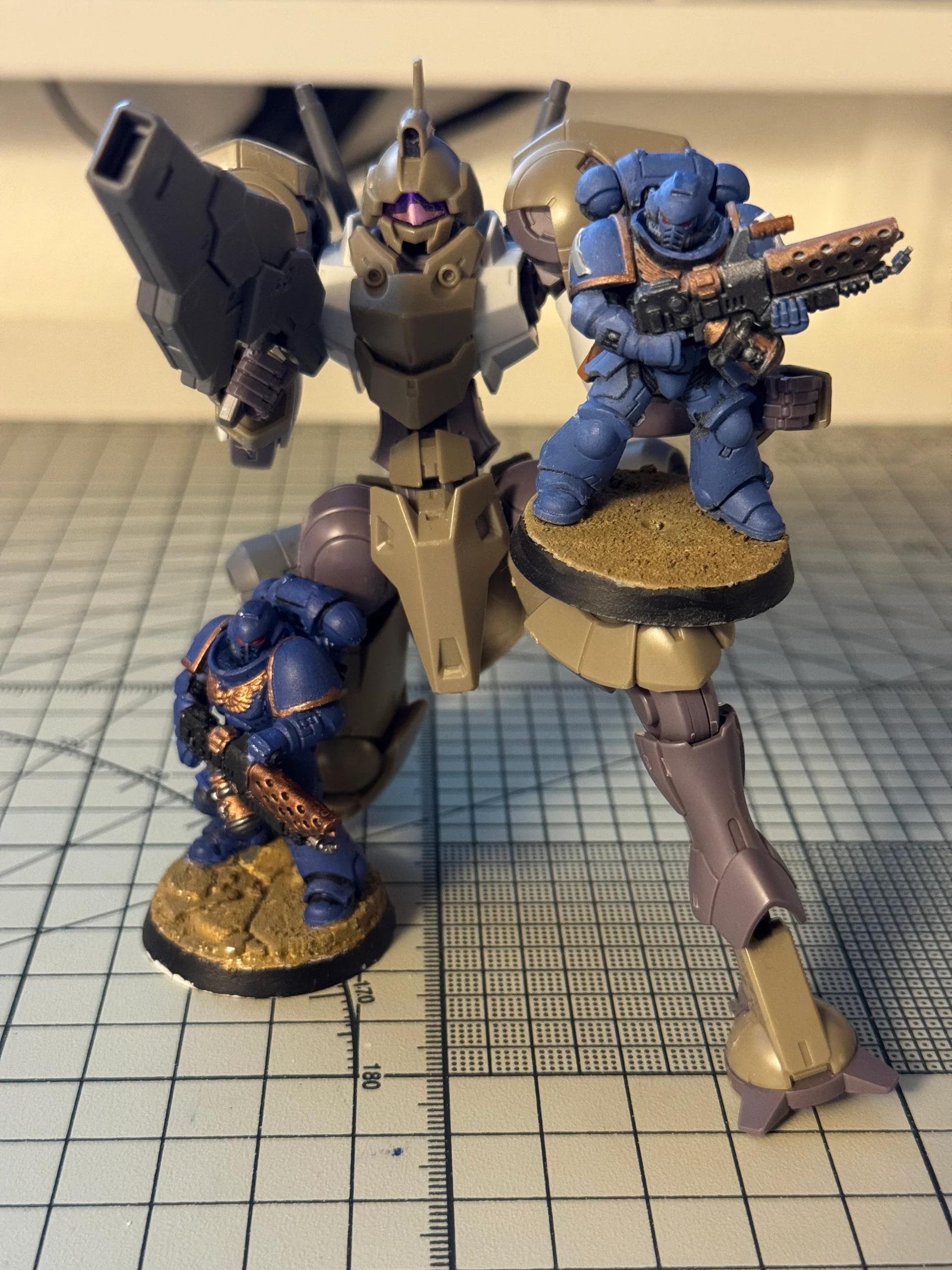
Short answer: your tools transfer completely, your hands transfer mostly, and your expectations don't transfer at all.
If you build Gunpla and you've been circling Warhammer 40K — maybe because a starter set caught your eye, maybe because half your feed is suddenly grey plastic — this is the honest version of what you're walking into. Written by someone who does both, badly at first, and still does.
I'm not going to sell you on 40K. Some of you should stay exactly where you are, and I'll tell you which of you.
What's the honest difference between the two hobbies?
Here it is in one line each.
Gunpla is a building hobby that produces a finished object in an afternoon. You open a box, snap parts together, and stand a poseable robot on your shelf. Paint is optional because Bandai molds the colors in. The kit is done when you say it's done.
Warhammer 40K is a painting-and-gaming hobby that produces an army over months. You open a box, glue parts together, and hold a grey plastic soldier that will look unfinished until you paint it. Then you do that nine more times, because a squad is ten models. Then you play a game with it.
Those are different hobbies that happen to share a material.
The mistake most crossover builders make — the one I made — is assuming 40K is "Gunpla but military." It isn't. The building is the smallest part of 40K. Assembly is the price of admission; painting is the actual hobby.
If that sounds like a downgrade, stay with Gunpla. If it sounds like the part you've been missing, keep reading.
Which of your tools transfer?
Nearly all of them. This is the genuinely good news, and it's the reason a Gunpla builder has a shorter runway into 40K than someone starting from zero.
Transfers directly, no changes:
Nippers. Same tool, same job. Your GodHand or DSPIAE cuts GW sprues exactly like it cuts Bandai runners. If anything, GW plastic is slightly softer and more forgiving.
Hobby knife. Same nub cleanup, same mold-line work. You'll actually use it more — GW models have more visible mold lines than modern Bandai kits.
Sanding sticks. Same grits, same purpose.
Cutting mat. Obviously.
Tweezers, if you have them. More useful in 40K than Gunpla, because the parts are smaller.
What you'll need to add:
Plastic cement (Tamiya Extra Thin or the GW equivalent). Non-negotiable — these kits do not snap together.
Primer. Rattle can or brush-on. Paint does not stick reliably to bare plastic.
Brushes. A decent synthetic set. You do not need sable to start.
Paints. This is the real cost, and I'll get to it.
If you've got a working Gunpla bench, you're maybe $60–80 of consumables away from painting your first 40K model. That's a meaningfully lower barrier than the hobby's reputation suggests — and it's why the crossover makes more sense from this direction than the other way around.
Everything in the "transfers directly" list, you can find in our tools collection — those are the same nippers, knives, and sanding sticks I use on both hobbies. The paints and cement you'll want from a dedicated miniatures supplier; we don't stock Games Workshop products.
Which of your skills transfer?
More than the 40K community gives Gunpla credit for, and more than the Gunpla community realizes.
Nub removal and mold lines. You already know how to clip a gate without stress-marking plastic, and you already know the two-cut method. That skill is worth real hours in 40K, where a visible mold line across a shoulder pad will haunt you the second you apply a wash.
Patience with small parts. If you've built a Real Grade, a Space Marine's kneepad will not intimidate you. You've handled worse.
Reading assembly diagrams. GW instructions are less elegant than Bandai's, but the literacy is the same.
Panel lining becomes washes. This is the biggest conceptual carry-over. A GW "shade" is the same physics as panel lining: thin dark pigment flowing into recesses, creating shadow and definition. You already understand why it works. In 40K you apply it over the whole model rather than into engraved lines, but the instinct is identical.
Knowing when to stop. Gunpla teaches restraint with panel liner — over-apply and the kit goes muddy. Exact same lesson with washes.
What doesn't transfer: brush control. If you've been a snap-build-and-panel-line builder, you have no brush hours, and there's no shortcut for that. It's a physical skill built by repetition, and your first squad is the repetition. Accept it.
What's genuinely different?
Five things, in rough order of how much they'll surprise you.
Glue is mandatory, and it's a skill. Plastic cement doesn't stick parts together — it melts and welds them. Too little and the joint fails. Too much and you get a smeared, blobby seam and fingerprints in soft plastic. Coming from snap-fit, this feels alarmingly permanent, and it is. Practice on something cheap.
There is no color separation. This is the big one. A Gunpla kit looks finished out of the box because Bandai molds each color in separate plastic. A 40K kit is one color — usually grey — and it stays that way until you paint it. There's no "I'll just snap it and panel line it" option. Unpainted, it reads as unfinished, because it is.
The unit of work is a squad, not a model. You finish a Gunpla kit and you're done — one object, complete, on the shelf. You finish one Space Marine and you have one-tenth of a squad. The satisfaction curve is completely different: longer, flatter, with the payoff at the end rather than the same evening.
There's a game attached, and it changes. Gunpla has no rules layer. A 2015 High Grade is exactly as valid today as the day it released. 40K has rules that get revised, and editions that reset every three years or so — the game just moved to its 11th Edition in June. Your models never stop being models, but their rules change out from under you. Some people find that energizing. Some find it exhausting. Know which you are.
You need people. You can build Gunpla alone forever and lose nothing. 40K's game layer needs an opponent, which means a local store, a club, or patient friends. Plenty of people paint 40K models and never play — that's completely legitimate — but if you want the game, you need a scene.
What does it actually cost?
Straight numbers, no softening.
Gunpla entry: ~$15–25 for a High Grade kit, plus ~$50 of tools you buy once. Second kit onward: $15–30 each, no additional overhead. You can build indefinitely on that.
40K entry: a starter set (currently in the $100–170 range depending on which), plus ~$60–80 in paints, brushes, primer, and cement. Call it $200–250 to get one small force painted, assuming you already own nippers and a knife from Gunpla.
Ongoing: this is where they diverge hard. Gunpla scales linearly — one kit, one price, done. 40K armies grow, and GW raises prices regularly. A single character model can run $35–50. A squad box, $60. A tank, $85+. A "finished" army is not a fixed target; it's a moving one, and the hobby's culture actively encourages expansion.
There's also the grey-plastic problem. Every 40K hobbyist has a pile of unassembled or unpainted boxes — the community jokes about it constantly. Gunpla has a backlog culture too, but a Gunpla backlog is shelf-ready in an afternoon each. A 40K backlog is dozens of hours of painting.
Honest read: 40K costs more per unit of finished satisfaction, especially early. If the money matters, that's not a small consideration, and you shouldn't let anyone wave it away.
How long does it actually take?
Gunpla: Entry Grade, 1–2 hours. High Grade, 2–4. Real Grade, 6–10. Finished, displayable, same day.
40K, per model: assembly 20–40 minutes. Priming, 10 minutes plus drying. Painting to a decent tabletop standard, 1.5–3 hours for a first-timer, 45–90 minutes once you're fluent.
40K, per squad of ten: realistically 10–20 hours of painting for a beginner. Spread across evenings, that's a few weeks.
That comparison is the whole difference in one place. Gunpla gives you a finished thing tonight. 40K gives you a finished thing next month, and it looks better because you made every part of it.
Neither is superior. They serve different appetites, and honestly they serve different moods — which is the actual argument for doing both.
What should you buy first?
If you're coming from Gunpla and you want the lowest-risk entry:
Download the free rules first. Games Workshop released the full 11th Edition core rules as a free PDF and in their free app. Read them before you spend anything. If the game doesn't appeal on the page, you've saved yourself $200 and learned something real.
Buy one small box, not a starter set. This is contrarian advice, and I stand by it. A single character or a five-model squad — $30–40 — lets you assemble, prime, and paint one thing before committing to an army. If you hate the painting, you're out $40 instead of $250. If you love it, the starter set is still there.
Buy paint last, and buy few. Six pots and a brush will take you further than a 30-pot starter collection. Most beginner paint sets are mostly colors you won't use. Buy for the specific model in front of you.
Prime with a rattle can, outdoors, on a dry day. Skip the airbrush question entirely for now.
The order that ruins people: buy the big box → get overwhelmed → assemble everything → never paint any of it. Doing it small and in sequence beats doing it impressively.
What I got wrong starting out
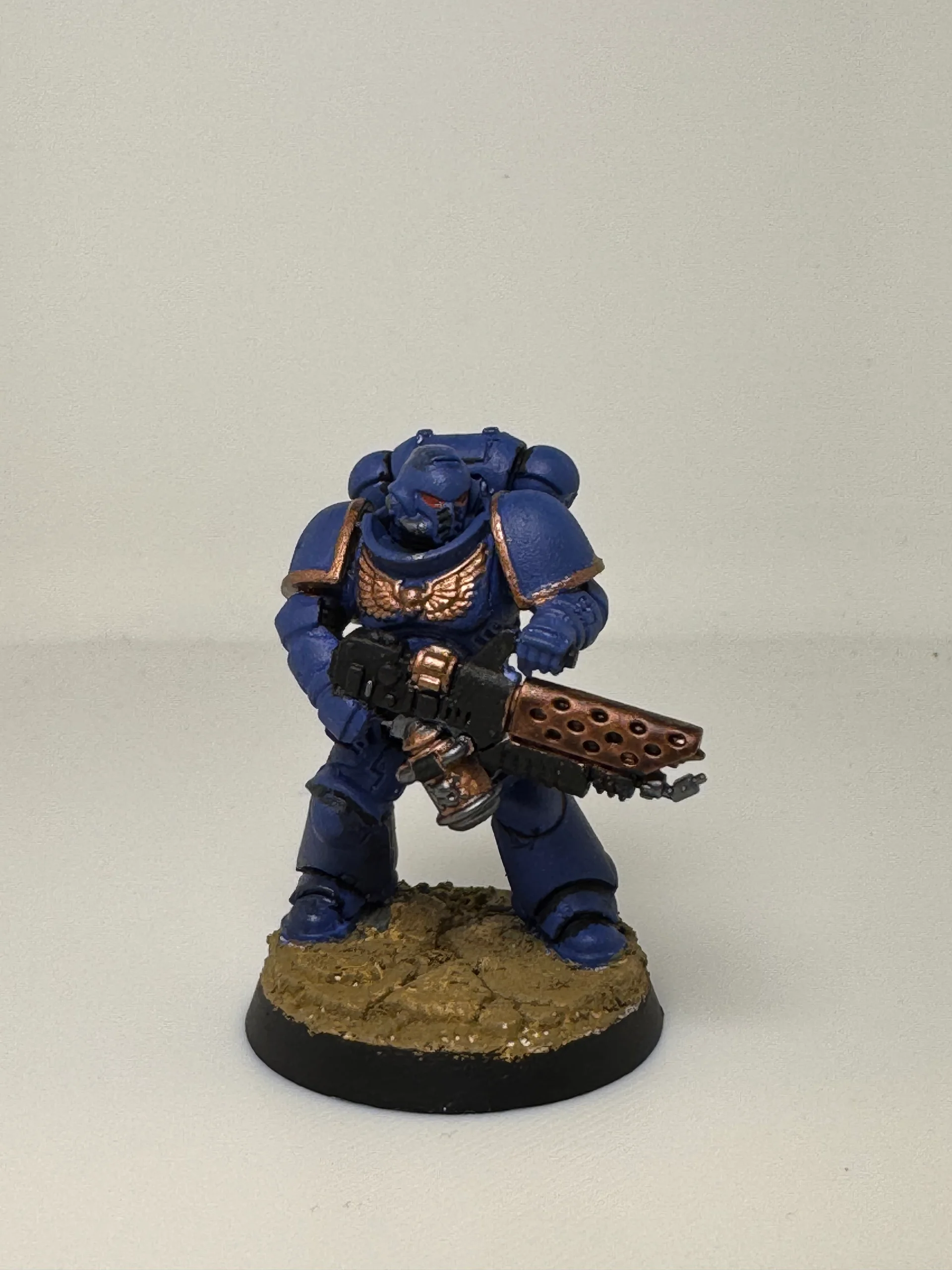
I didn't thin my paints. Straight from the pot, thick, filling in every detail I'd just carefully cleaned up. Nobody tells you this, and every guide assumes you know. Paint should go on in thin coats — two thin beats one thick, always. My first models looked like they'd been dipped.
I primed too close. Rattle can six inches away instead of twelve, on a humid day. The result was a gritty, chalky texture I had to strip. Prime in light passes from further away than feels right.
I tried to paint at Gunpla speed. I'm used to finishing something in an evening. I forced a squad in two nights and it showed — sloppy edges, missed spots, no patience for the second coat. 40K punishes rushing in a way snap-building doesn't.
I bought too much at once. Classic. A pile of boxes bought in enthusiasm, most still grey months later. Buy one thing, finish one thing.
I expected the models to look good unpainted. They don't. I knew this intellectually and was still deflated holding a finished-assembly grey squad. It's not a build you display; it's a build you've started.
None of this is discouraging in retrospect. It's just the toll. Everyone pays it, and most guides pretend they didn't.
Should you actually make the jump?
Honest sorting, because not everyone should.
Stay with Gunpla if:
You love the building and merely tolerate painting.
You want a finished thing the same day.
Your budget is tight and you want it to stay predictable.
You have no local gaming scene and no interest in the game.
Your backlog is already guilt-inducing.
Try 40K if:
You've been panel lining and topcoating and wanting more finishing work.
You've thought "I wish I could paint, but Gunpla doesn't really need it."
Long projects appeal to you more than quick wins.
You want a hobby with a social or game layer attached.
You want a higher skill ceiling to climb.
Do both if: you want a fast hobby and a slow hobby. This is where I've landed, and it's genuinely the best reason to cross over. Some weeks I want a kit finished tonight. Some weeks I want to spend three hours on one shoulder pad. Having both means never forcing the wrong one.
The two hobbies don't compete for the same evening. They compete for different moods.
What if you want the models but not the painting?
Completely legitimate, and more common than people admit. Some people love the game, the lore, and the collecting, and have no interest in holding a brush — or no time to.
That's what our Bounty Board is for: commission a painter for an army you won't get to, or list your own work if you're the one with the brush and the free evenings. It works for Gunpla builds too, in both directions.
The commission market for painted miniatures has lived in scattered DMs, forum threads, and Instagram replies for years. There's no good reason for that.
Where to go next
If you're crossing over: download the free rules, buy one small box, and paint one model before you buy anything else.
If you're staying with Gunpla: nothing here was an argument that you're missing out. You're not.
And if you want the deeper version of the 40K side specifically — what to buy, what to skip, how to actually start — a full beginner's guide to starting Warhammer 40K in 2026 is coming shortly.
Either way: the nippers on your bench work for both. That's a better starting position than most people get.
Frequently asked questions
Can I use my Gunpla nippers on Warhammer models?
Yes. Same tool, same job — GW plastic is actually slightly softer than Bandai's. Your nippers, hobby knife, sanding sticks, and cutting mat all transfer directly.
Do Warhammer models snap together like Gunpla?
No. They require plastic cement, which melts and welds the plastic rather than just sticking it. It's a genuinely different skill and worth practicing on something cheap first.
Do I have to paint Warhammer miniatures?
Effectively yes. Unlike Gunpla, GW kits are molded in a single color (usually grey) with no color separation, so they read as unfinished until painted.
Is Warhammer 40K more expensive than Gunpla?
Yes, meaningfully. Expect $200–250 to get a small force assembled and painted, versus $15–25 per Gunpla kit on top of one-time tools. 40K armies also grow over time rather than being one-and-done purchases.
How long does it take to paint a Warhammer squad?
For a beginner, roughly 10–20 hours for a ten-model squad, spread over several weeks. A single model runs 1.5–3 hours at first, dropping to under 90 minutes as you get fluent.
Can I play Warhammer 40K without painting?
You can, and plenty of people do at home. Most organized events and stores expect painted armies, though standards vary widely by venue.